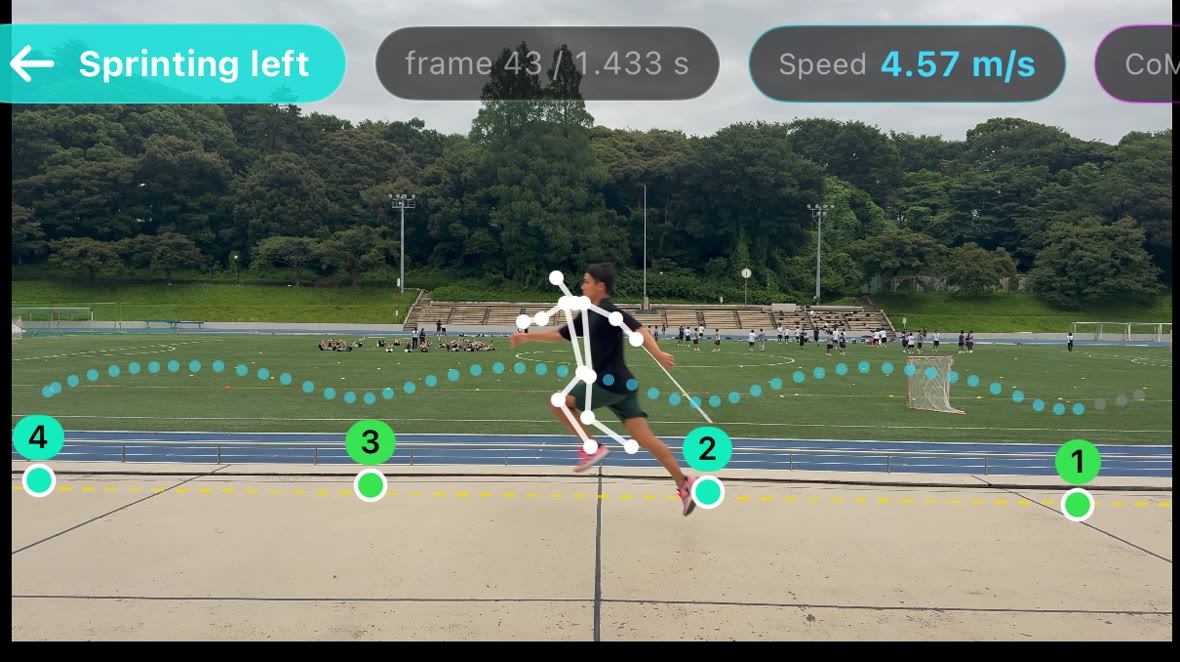
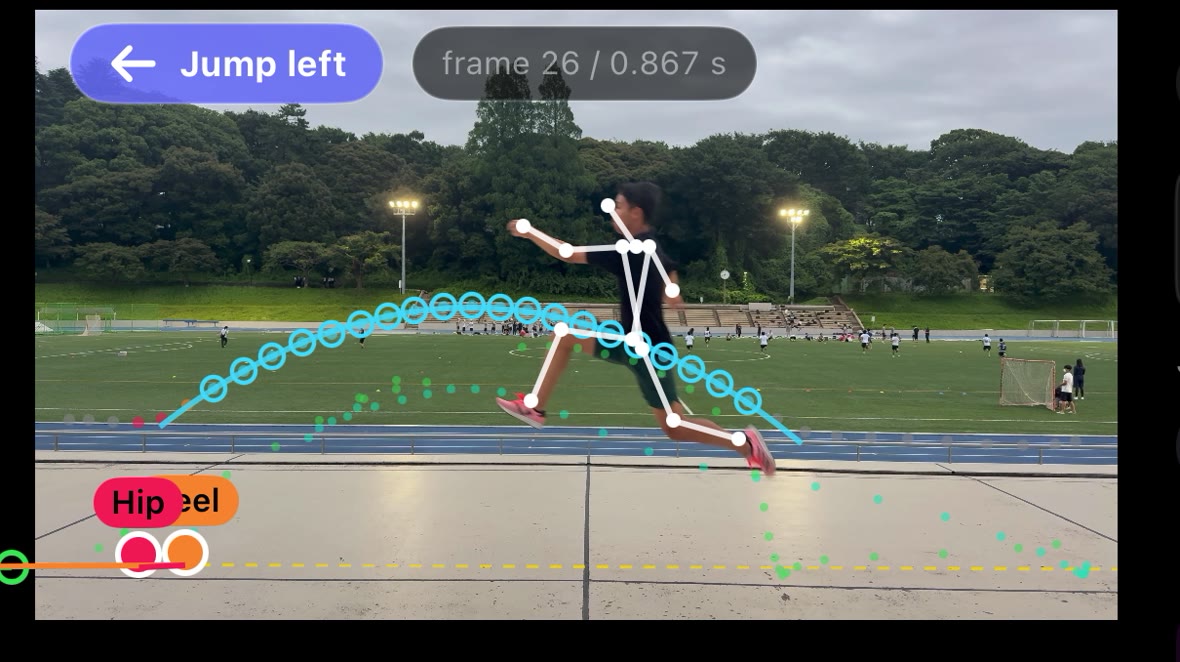
骨格の検出は Apple や Google のものに乗ります。Actynq が作っているのはその上——実寸にする定規、接地や踏切の事象、そして自分の数字を疑う検証です。ここでは仕組みと、いま数字で言えることを、そのまま書きます。 Skeleton detection rides on Apple and Google. What Actynq builds sits above it: rulers that give real units, event detection for contact and take-off, and verification that doubts its own numbers. This page states how it works and what we can say in numbers today.
使う人がやることは、撮ることだけです。あとの3段は端末の中でアプリが行います。動画はサーバーに上がりません。All you do is film. The other three steps run inside the phone. The video never leaves the device.
iPhone 1台。三脚に固定して、できれば 120fps 以上で。動画の向きや時間軸がおかしい場合は、ここで検査して弾きます。One iPhone on a tripod, ideally 120 fps or more. Orientation and timebase problems in the file are caught here.
カメラ1台の映像には物差しがありません。レーン幅 1.22m、ハードルの間隔、踏切板、やりの長さ——種目ごとの既知の寸法を定規にします。A single camera has no ruler. Lane width (1.22 m), hurdle spacing, the take-off board, the javelin's length — each event's known dimensions become the ruler.
接地・離地・踏切・着地・リリース。学習モデルと幾何の2経路で、1コマより細かい時刻まで求めます。Contact, toe-off, take-off, landing, release — found by two independent paths, a learned model and geometry, down to sub-frame timing.
2経路の差、重力との整合、コマ数、縮尺の安定。4つの検査を通ったときだけ、数字と不確かさの幅を返します。外れたら、出しません。Gap between the two paths, consistency with gravity, enough frames, stable scale. Only when all four checks pass do we return a number with its uncertainty band. Otherwise, nothing.
いちばん下の骨格推定は、Apple Vision や MediaPipe、Stanford の OpenCap に乗ります。そこでは戦いません。Actynq が作り、提供しているのは上の3層です。The bottom layer — pose estimation — rides on Apple Vision, MediaPipe and Stanford's OpenCap. We don't compete there. The three layers above are what Actynq builds and provides.
スマホの動画は、間違っていても小数点2桁で答えます。誤差は画面に映らない。だから Actynq は、接地なら2つの独立した方法が同じコマを指すときだけ、数字を返します。手持ち撮影では、23%の計測で数字を出しませんでした。Phone video answers to two decimal places even when it's wrong; the error never shows on screen. So Actynq returns a contact time only when two independent methods point at the same frame. On handheld footage, we withheld 23% of results.
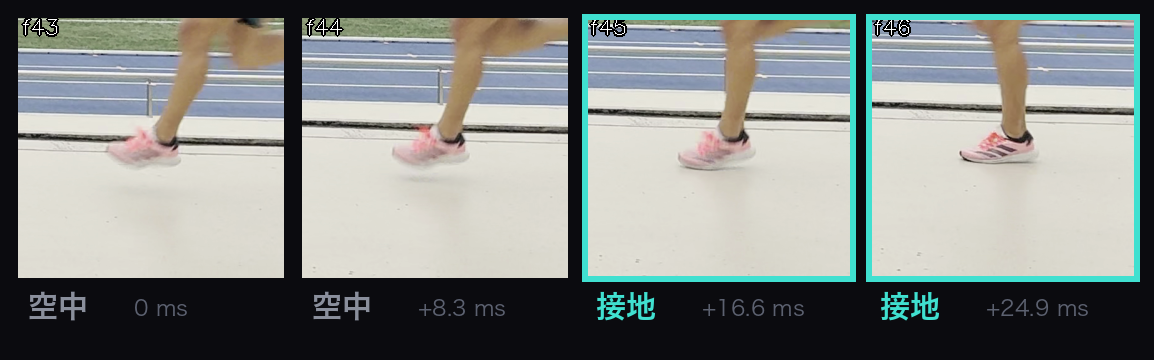
100m の接地時間は 80–110ms。走幅跳の踏切はエリートでも 10cm ばらつく。計測器は、そのスケールで語らなければ意味がありません。A 100 m ground contact lasts 80–110 ms. Even elite long-jump take-offs scatter by 10 cm. An instrument has to speak at that scale.
予測を隠して作った18試技のラベルに対し、15モデルすべてが 7.8–11.1ms。接地時間の約1/10。Against 18 trials labelled blind, all 15 models fall within 7.8–11.1 ms — about a tenth of a contact.
真値3本・60fps。観客席からの4K映像でも、真値5本で平均誤差 0.155m、全本が不確かさの帯の中。3 ground-truth jumps at 60 fps. From the stands in 4K: 5 jumps, mean error 0.155 m, all within the uncertainty band.
同一試技を光学式モーションキャプチャとフォースプレートで測ります。届かなければ、届かなかったと公表します。The same trials measured with optical motion capture and force plates. If we fall short, we publish that we fell short.
上の数値は自社検証によるものです。光学式との対照は未了で、±0.5cm は目標値であり、達成済みではありません。「業界最高」のような言葉は使いません。どの条件でどこまで信頼できるかを確かめ、検証できた範囲から順に使えるようにしています。Figures above are from internal validation. The optical comparison is not complete; ±0.5 cm is a target, not an achievement. We don't use words like "industry-leading". We establish how far each condition can be trusted, and release what has been verified.
三脚を立てられるグラウンドもあれば、手持ちで撮るしかない体育館もあります。どちらの条件でも計測できるように、並行して開発しています。Some tracks allow a tripod; some gyms only allow handheld. Both are developed in parallel so either condition can be measured.
iPhone を三脚に固定して撮り、実寸スケールで動作を復元します。カメラが動かないぶん条件が安定するため、スプリントをはじめとするフィールド計測の基盤です。Shoot with the iPhone fixed on a tripod and reconstruct motion at real-world scale. A stationary camera keeps conditions stable, so this is the foundation for sprint and field measurement.
手持ちで撮っても計測精度を保つための技術です。三脚を置けない場所でも、撮れる場所がそのまま計測の場所になります。Built to hold measurement quality when filming handheld. Where a tripod won't fit, anywhere you can film becomes somewhere you can measure.
共同研究・検証、記録会や練習での実演計測、SDK の組み込みのご相談を受け付けています。Joint studies and validation, live demos at meets and practice, SDK integration.